
TL;DR:
- Business strategy is a continuous, organization-wide discipline shaping every decision.
- Effective strategies require clear objectives, alignment, and active leadership engagement.
- Using and revisiting frameworks like BCG Matrix and SWOT enhances decision-making and resource allocation.
Most executives assume strategy is something you set once a year, present in a boardroom, and then hand off to managers to execute. That assumption is exactly why so many well-crafted plans collect dust. Business strategy isn’t a document. It’s a living discipline that shapes every decision your organization makes, from where you invest capital to how you develop your people. Whether you lead a 15-person firm or a 5,000-person enterprise, the principles are the same: clarity of direction, alignment of resources, and the leadership to see it through. This guide covers the frameworks, allocation methods, and leadership behaviors that turn strategy from theory into measurable results.
Table of Contents
- What is strategy in business?
- Core frameworks: Tools for strategic thinking
- Strategic resource allocation: From planning to execution
- Leadership and strategy: Driving organizational excellence
- A fresh perspective: Rethinking strategy for modern leaders
- Take your strategy to the next level with Dumex Business Consulting
- Frequently asked questions
Key Takeaways
| Point | Details |
|---|---|
| Strategy vs. tactics | Strategy sets the long-term direction, while tactics are short-term steps to reach those goals. |
| Frameworks empower leaders | Tools like the BCG Matrix help prioritize resources and inform smart decisions. |
| Leadership drives execution | Successful strategies rely on leaders who align teams and adapt to change. |
| Resource allocation is critical | Investing in high-potential areas fuels growth and sustainability. |
What is strategy in business?
Strategy is the set of choices an organization makes to achieve a specific competitive position over time. It answers three questions: Where will we compete? How will we win? And what resources will we commit? Without clear answers to those questions, you don’t have a strategy. You have a wish list.
The confusion between strategy and tactics is one of the most common traps leaders fall into. Tactics are the specific actions you take to execute a strategy. Running a targeted LinkedIn campaign is a tactic. Deciding to position your firm as the premium provider in a niche market is a strategy. Both matter, but mixing them up leads to reactive decision-making and wasted resources.
Strategic alignment is what makes the difference between an organization that moves with purpose and one that spins its wheels. When every department, team, and individual understands how their work connects to the organization’s core objectives, execution becomes faster and more consistent. Effective strategy aligns resources towards core objectives for sustained growth, and that alignment starts at the top.
Leadership plays a non-negotiable role here. A strategy that lives only in the CEO’s head is not a strategy at all. Leaders must translate vision into concrete, measurable objectives that teams can act on. Consider what strong strategic objectives look like:
- Specific: Increase market share in the SME segment by 12% within 18 months
- Measurable: Track monthly revenue, customer acquisition cost, and retention rate
- Aligned: Every department’s quarterly goals connect to the same north star
- Adaptable: Built-in review cycles allow for course correction without losing momentum
“Strategy without execution is hallucination.” This sharp reminder from management thinkers captures why clarity of objectives matters as much as the ambition behind them.
Explore the business strategy overview to see how these principles apply across industries and organizational sizes. The foundation is always the same: know where you’re going, know why, and make sure everyone else does too.
Core frameworks: Tools for strategic thinking
With a clear definition of business strategy, leaders benefit from practical frameworks that structure their planning and evaluation. Frameworks are not magic formulas. They are lenses that help you see your organization and its environment more clearly so you can make better decisions.
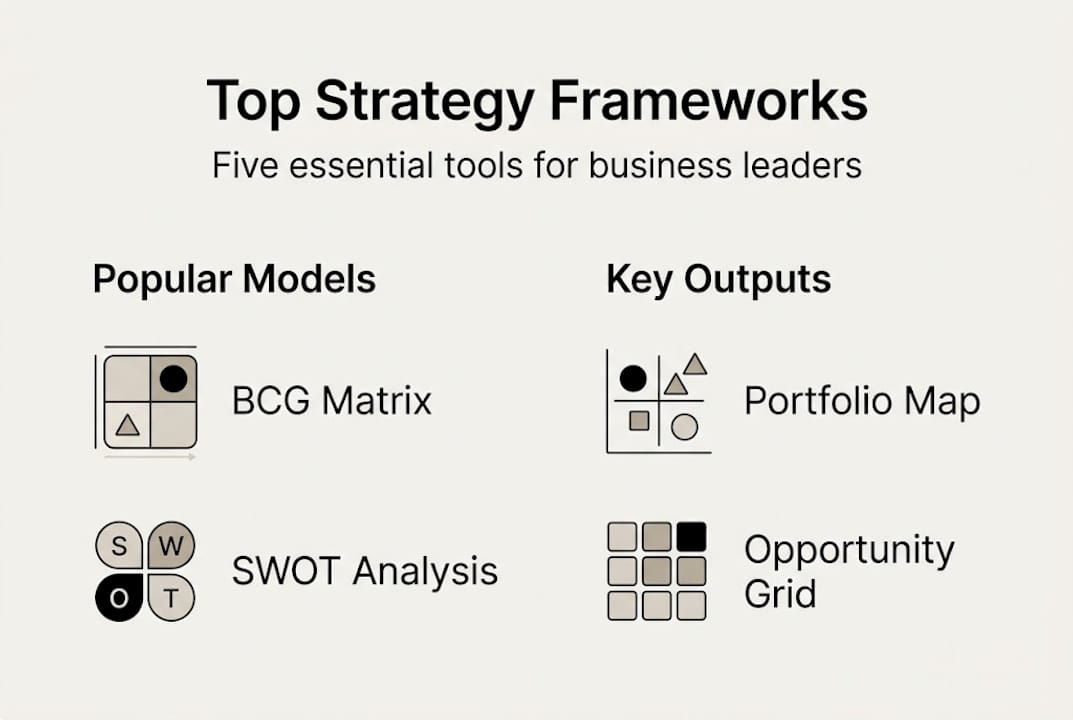
Here is a comparison of four widely used frameworks:
| Framework | Best used for | Key output |
|---|---|---|
| BCG Growth-Share Matrix | Portfolio analysis and resource allocation | Investment priorities by business unit |
| SWOT Analysis | Situational awareness and planning | Strengths, weaknesses, opportunities, threats |
| Porter’s Five Forces | Competitive landscape assessment | Industry attractiveness and positioning |
| Balanced Scorecard | Strategy execution and KPI tracking | Linked objectives across four perspectives |
The BCG Growth-Share Matrix categorizes your portfolio into Stars, Cash Cows, Question Marks, and Dogs, giving leaders a clear visual for resource allocation decisions. It’s one of the most practical tools for organizations managing multiple products, services, or business units.
Here’s how to apply frameworks without falling into common traps:
- Choose the right tool for the question. SWOT is great for broad situational awareness but too general for investment decisions. Use the BCG Matrix when you need to prioritize across a portfolio.
- Combine frameworks. Porter’s Five Forces tells you about the competitive environment. The Balanced Scorecard tells you how well you’re executing inside it. Used together, they give a fuller picture.
- Revisit regularly. A framework applied once becomes outdated. Build quarterly reviews into your planning cycle.
- Involve your leadership team. Frameworks built in isolation by one executive rarely gain organizational buy-in.
Pro Tip: The most common misapplication of the BCG Matrix is treating all “Dogs” as liabilities to cut immediately. Some low-growth, low-share units serve strategic purposes like anchoring client relationships or supporting a Star product. Always analyze context before making portfolio cuts.
Understanding how to apply a business consulting framework correctly can be the difference between a strategy that energizes your organization and one that creates confusion. When frameworks are used well, they drive clarity, sharpen consulting for growth conversations, and make resource decisions far less political. Review strategic planning best practices to understand how top-performing organizations build these habits into their culture.
Strategic resource allocation: From planning to execution
Once the strategic framework is selected, applying it to real-world resource allocation is where the rubber meets the road. Choosing a framework is the easy part. Deciding where to put your money, your people, and your attention is where strategy gets tested.

The BCG Matrix makes this concrete. Cash Cows fund Stars based on experience curve cost advantages, meaning your stable, profitable units should be generating the cash that fuels your high-growth opportunities. This isn’t just theory. It’s a discipline that prevents organizations from over-investing in declining units while starving their most promising ones.
Here’s how portfolio categories typically translate into resource decisions:
| Category | Market growth | Market share | Recommended action |
|---|---|---|---|
| Stars | High | High | Invest aggressively to maintain position |
| Cash Cows | Low | High | Harvest profits, fund other units |
| Question Marks | High | Low | Evaluate potential, invest selectively |
| Dogs | Low | Low | Divest or restructure unless strategic |
Moving from strategy formulation to execution requires more than a good plan. It requires a structured process:
- Audit current allocation: Where is your budget actually going versus where your strategy says it should go? The gap is often revealing.
- Prioritize by strategic impact: Not all investments are equal. Rank initiatives by their contribution to your core strategic objectives.
- Set clear ownership: Every resource commitment needs an accountable leader with the authority to act.
- Build in checkpoints: Monthly or quarterly reviews keep allocation aligned with changing market conditions.
The most common challenge leaders face is the pull of legacy investments. Units or programs that once drove growth but no longer do tend to accumulate resources through organizational inertia. Breaking that pattern requires both analytical rigor and leadership courage. Understanding the consulting services impact on resource decisions can help leaders build the objectivity needed to make those tough calls. For a deeper look at how consulting and resource allocation work together, explore how external perspective accelerates internal clarity.
Leadership and strategy: Driving organizational excellence
Resource allocation succeeds when leadership actively drives adoption and engagement across the organization. You can have the best strategy on paper and still fail if your leaders aren’t equipped to carry it forward.
Leaders are responsible for communicating strategy, aligning teams, and adapting to market changes. That’s not a passive role. It requires deliberate, consistent action across several dimensions:
- Communicate with clarity and repetition. People need to hear the strategy multiple times, in multiple formats, before it becomes part of how they work.
- Model the behaviors the strategy requires. If your strategy calls for innovation, leaders must visibly reward experimentation and tolerate calculated risk.
- Build accountability structures. Strategy without consequences for non-performance is optional. Tie team and individual goals explicitly to strategic priorities.
- Create feedback loops. Leaders who only push strategy downward miss critical signals from the front line. Build mechanisms for information to flow upward too.
Pro Tip: The hardest leadership challenge isn’t driving strategy during stability. It’s maintaining momentum through change. When markets shift or results disappoint, leaders who stay visible, explain the “why” behind adjustments, and keep teams focused on what they can control are the ones who preserve organizational trust.
“The best leaders don’t just set direction. They create the conditions where their teams can execute brilliantly, even when the plan changes.”
High-performing organizations are built by leaders who treat strategy as a team sport, not a top-down directive. Explore leadership and management insights to see how the best leaders develop these capabilities systematically. The corporate consultant expertise available through experienced advisors can also accelerate a leadership team’s ability to execute under pressure.
A fresh perspective: Rethinking strategy for modern leaders
Here’s an uncomfortable truth most strategy consultants won’t tell you: the majority of strategic plans fail not because the analysis was wrong, but because the organization wasn’t built to execute them. Leaders spend enormous energy on frameworks and presentations, then hand the plan to managers who were never part of building it and wonder why adoption is slow.
Modern strategy must be co-created, not delivered. When your leadership team, department heads, and even frontline managers contribute to shaping the direction, they become advocates rather than recipients. That shift alone dramatically improves execution rates.
Strategy also can’t be a once-a-year event. Markets move too fast. The organizations winning today treat strategy as a continuous conversation, not an annual retreat output. They build review rhythms, empower teams to flag misalignment early, and adjust without drama.
The real competitive advantage isn’t having the best strategy. It’s building an organization that can execute any good strategy faster than competitors. Explore corporate consulting insights to see how that kind of organizational agility gets built in practice.
Take your strategy to the next level with Dumex Business Consulting
For leaders ready to sharpen their strategy and drive meaningful change, expert guidance can accelerate progress significantly.
At Dumex Business Consulting, we work with business leaders to translate strategic intent into operational reality. Whether you need to clarify your direction, strengthen your leadership pipeline, or build the systems that sustain performance, our team brings the frameworks and experience to get you there. Browse our business strategy resources to start building your roadmap. Explore our leadership training programs designed for executives who want to lead strategy, not just approve it. And if operational consistency is a priority, our quality management programs provide the structure your teams need to perform at their best.
Frequently asked questions
What is the most effective business strategy framework?
The BCG Growth-Share Matrix is widely used to allocate resources across portfolios, categorizing units into Stars, Cash Cows, Question Marks, and Dogs to guide investment priorities toward growth and sustainability.
How do leaders ensure strategy is executed?
Leaders communicate strategy, secure buy-in from teams, establish clear accountability, and adapt the plan as market conditions evolve to keep execution on track.
Can strategy change over time?
Yes, strategy must evolve continuously to address shifting market conditions, emerging opportunities, and new competitive pressures, ensuring the organization stays relevant and competitive.
What is the difference between strategy and tactics?
Strategy is the long-term plan that defines where and how an organization will compete, while tactics are the specific short-term actions taken to implement that strategy on the ground.
Why is resource allocation so important in strategic planning?
Cash Cows fund Stars through experience curve advantages, making disciplined allocation the mechanism that ensures your highest-potential areas receive the investment they need to grow.