TL;DR:
- Only 3% of organizations achieve their strategic transformation goals despite heavy investments. Successful transformation requires unified leadership, process redesign, people-focused strategies, measurable metrics, and short-term wins. Common failures include unclear goals, misaligned budgets, weak ownership, cultural superficiality, and organizational fatigue.
Only 3% of organizations fully achieve their strategic transformation objectives. That number should stop every executive in their tracks. Despite billions spent on consultants, restructuring programs, and technology overhauls, most organizations end up with motion rather than momentum. The uncomfortable reality is that transformation has become a buzzword that masks a deeper problem: leaders often confuse activity with progress. This guide breaks down what strategic transformation actually means, what separates the rare winners from the majority, and how your organization can build the discipline to move from ambition to measurable outcome.
Table of Contents
- Defining strategic transformation: Beyond buzzwords
- Core pillars of successful strategic transformation
- Major pitfalls and real-world failure patterns
- Strategic transformation in action: Frameworks and next steps
- Why strategic transformation is harder and more necessary than leaders think
- Take your strategic transformation further with expert consulting
- Frequently asked questions
Key Takeaways
| Point | Details |
|---|---|
| True transformation is strategic | It requires a broad reset of business direction, not just operational changes. |
| Unified leadership is critical | Sustained transformation hinges on visible, top-down commitment and follow-through. |
| Most initiatives miss objectives | The majority of strategic transformations do not deliver their original goals without relentless focus. |
| Performance must match engagement | Combining culture-building with performance discipline yields greater, more lasting success. |
| Fewer, better efforts win | Lasting organizational change comes from smart, capability-building initiatives over constant activity. |
Defining strategic transformation: Beyond buzzwords
Strategic transformation is not a software rollout. It is not a rebranding exercise. And it is definitely not a series of workshops followed by a new org chart. At its core, strategic transformation is a holistic, organization-wide shift in how a company creates value, competes in its market, and positions itself for future relevance. It touches every layer of the business, from operating models and revenue streams to culture and leadership behavior.
What drives organizations to pursue it? The triggers are usually sharp and unavoidable:
- Market disruption that makes the current model obsolete
- New competitors with fundamentally different cost structures
- Regulatory shifts that force new operating standards
- Technology changes that redefine customer expectations
- Internal performance decline that signals a structural problem
Understanding this distinction matters because most companies apply a business consulting framework designed for incremental improvement to a challenge that actually requires systemic reinvention. The result is what researchers call “transformation theater,” where the organization runs through the motions of change without ever altering the underlying system.
“Transformation theater happens when organizations prioritize the appearance of change over its actual impact. Activity accumulates, but outcomes never materialize.” The case against perpetual transformation
This is a critical distinction when designing organizational consulting strategies. True strategic transformation requires a rethink of what value the organization delivers, to whom, and how. It demands that leaders challenge assumptions they have held for years, not just optimize what already exists.
The danger is that “transformation” has been applied so broadly that it now covers everything from a new CRM system to a full business model pivot. When everything is a transformation, nothing is. Leaders who fail to draw this line end up burning resources on initiatives that feel significant but leave core performance gaps untouched.
Core pillars of successful strategic transformation
So what actually works? Kearney’s 2025 Transformation Study identifies a consistent set of success factors across organizations that beat the odds. These are not soft principles. They are structural disciplines that high-performing organizations embed from day one.
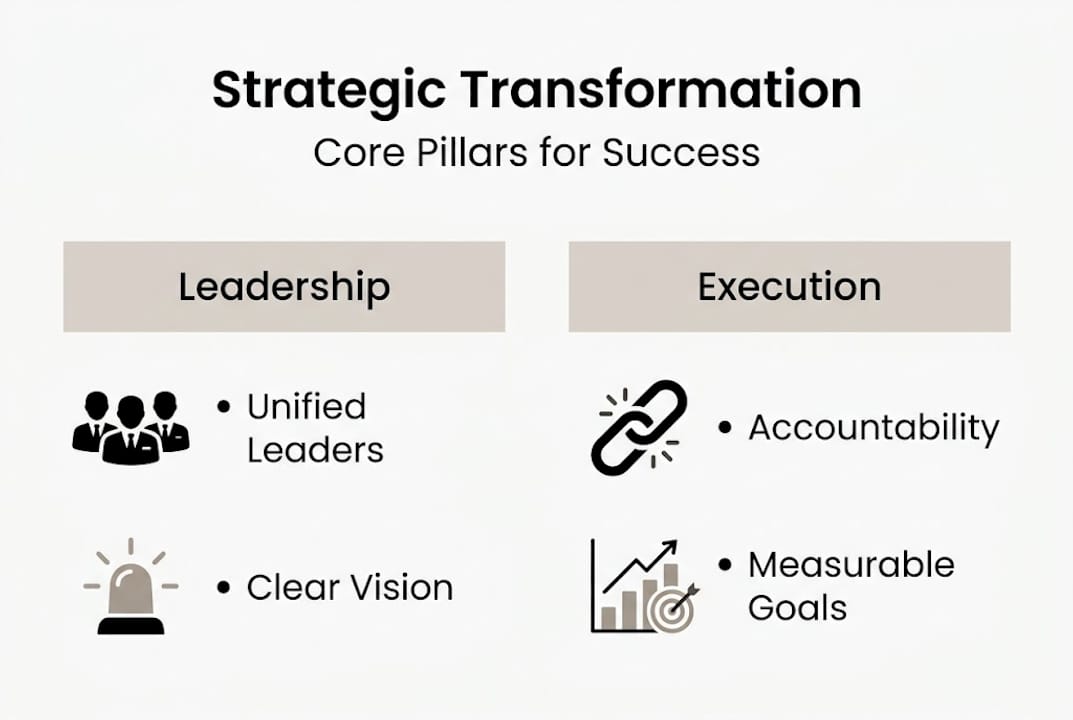
- Unified, visible leadership. The C-suite must speak with one voice. When executives send mixed signals or delegate transformation ownership to middle management, the initiative loses credibility fast.
- Fundamental process change. Surface-level tweaks do not move the needle. Winning transformations redesign core workflows, decision rights, and resource allocation models.
- People focus at every stage. Communicating the vision clearly, investing in upskilling, and building genuine buy-in are non-negotiable. Resistance is not a soft problem. It is a strategic risk.
- Short-term wins alongside long-term capacity. Early wins create organizational confidence. But they must be paired with investments that build lasting capability, not just quarterly optics.
- Relentless metrics tracking. Every transformation goal must map to a measurable business outcome. Vague targets produce vague results.
Pro Tip: Assign a dedicated transformation office with direct C-suite reporting lines. Organizations that treat transformation as a side project alongside normal operations consistently underperform those that give it dedicated governance and accountability structures.
| Pillar | What it looks like in practice | Common mistake |
|---|---|---|
| Unified leadership | CEO and board aligned on outcomes | Delegating to a project manager |
| Process redesign | Core workflows rebuilt from scratch | Digitizing broken processes |
| People investment | Structured upskilling and communication | Announcing change without support |
| Short-term wins | Visible milestones in first 90 days | Waiting for the big reveal |
| Metrics discipline | KPIs tied directly to business outcomes | Tracking activity instead of impact |
These pillars are not independent. They reinforce each other. Leadership without metrics is inspiration without accountability. Metrics without people investment is data without adoption. Understanding why transformations struggle often comes down to treating these pillars as optional rather than foundational. Organizations serious about business transformation for growth need all five working in concert.
Major pitfalls and real-world failure patterns
Knowing what works is only half the equation. The other half is understanding why so many organizations fall short. 83% of transformations miss their targets at least half the time. These are not random failures. They follow recognizable patterns.
The most common failure modes include:
- Unclear or shifting goals that leave teams without a fixed target
- Misaligned budgeting that funds the announcement but not the execution
- Lack of top-down ownership, where the CEO champions the vision but does not stay engaged
- Cultural talk without performance discipline, where values posters replace accountability systems
- Isolated changes in technology or org structure that never connect across functions
| Failure pattern | Root cause | Warning sign |
|---|---|---|
| Unclear goals | Strategy not translated to execution | Teams define success differently |
| Budget misalignment | Resources follow old priorities | Transformation funded from margins |
| Weak ownership | Leadership disengages after launch | Middle management absorbs all pressure |
| Culture without discipline | Soft metrics replace hard outcomes | Engagement scores rise, performance flat |
| Functional isolation | No cross-functional integration | Each unit runs its own transformation |
One of the most underappreciated failure patterns is transformation fatigue. When organizations launch initiative after initiative without building the underlying capacity to absorb and sustain change, people stop believing. Energy dissipates. The next transformation starts with a skeptical workforce that has seen it all before.

Pro Tip: Before launching any new transformation initiative, audit the outcomes of the last three. If you cannot clearly articulate what changed and why, you are likely adding to fatigue rather than building momentum.
Effective change strategies address this by sequencing initiatives deliberately, building organizational capacity between cycles, and ensuring that each effort leaves the organization stronger, not just different.
Strategic transformation in action: Frameworks and next steps
Diagnosing the problem is necessary. But leaders need a path forward. The most important mindset shift is moving from project-based thinking to capability-building. A project has a start date and an end date. A capability is something the organization can use repeatedly, across multiple challenges, for years.
Here is a practical checklist for your next transformation initiative:
- Assess readiness honestly. Survey leadership alignment, available resources, and current change capacity before committing. Overestimating readiness is one of the most expensive mistakes organizations make.
- Build executive sponsorship early. Identify two or three senior leaders who will visibly champion the effort, not just sign off on it.
- Align incentives with outcomes. If your performance management system still rewards the old behaviors, your transformation will stall. Incentives must shift before behaviors do.
- Define cross-functional impact metrics. Every initiative needs metrics that cross departmental lines. If only one function is measuring success, you are not transforming the organization.
- Build in learning loops. Schedule regular reviews to assess what is working, what is not, and what needs to change. Transformation is not a straight line.
Pro Tip: Treat your transformation roadmap as a living document. Organizations that build adaptability into the process itself, rather than treating it as a fixed project plan, consistently outperform those that lock in a rigid sequence of steps.
Experts at Harvard Business Review note that not every challenge requires a full-scale transformation. Knowing when to transform and when to optimize is itself a strategic skill. Pairing that judgment with business growth consulting expertise helps organizations avoid the trap of over-engineering solutions to problems that need focused execution, not reinvention.
Why strategic transformation is harder and more necessary than leaders think
Here is the uncomfortable truth most transformation frameworks avoid: more change does not mean better outcomes. Perpetual transformation costs organizations an estimated $2.3 trillion annually in lost productivity, failed initiatives, and organizational fatigue. Yet many leaders still measure ambition by the number of initiatives on the roadmap.
The real differentiator is not how often you transform. It is the muscle your organization builds for sustainable change. Companies that do fewer, better-executed transformations consistently outperform those in a constant state of reinvention. Relentless metrics and visible leadership matter far more than themed workshops or culture campaigns.
At Dumex Business Consult, we have seen this pattern play out repeatedly. Organizations that invest in top consulting practices and build genuine change capability between initiatives do not just survive disruption. They use it as an advantage. The goal is not to be always transforming. It is to be always ready.
Take your strategic transformation further with expert consulting
Understanding the principles of strategic transformation is a strong start. Executing them under real organizational pressure is a different challenge entirely.

Dumex Business Consult works with corporate leaders to design and deliver transformation initiatives that produce measurable results, not just activity. From strategy design to leadership development and execution support, our business strategy services are built for organizations that need more than a plan. They need results. Explore our growth consulting solutions or start with a deeper look at what business consulting can do for your organization’s next phase.
Frequently asked questions
What is the core difference between strategic transformation and operational improvement?
Strategic transformation reshapes the overall direction and value creation of a company, while operational improvement fine-tunes existing processes without shifting strategy. One changes where you are going; the other makes the current journey more efficient.
Why do most strategic transformation efforts fail?
83% miss targets at least half the time due to unclear goals, lack of unified leadership, and focusing on activity rather than business outcomes. The gap between launching a transformation and landing one is almost always a governance and accountability problem.
How can leaders ensure their transformation initiative drives real results?
Leaders must set clear outcomes, focus on building change capability, and hold teams accountable with ongoing metrics. Unified leadership and relentless metrics tracking are the two factors most consistently linked to transformation success.
Is transformation fatigue real, and how can it be avoided?
Yes, frequent transformations without building adaptability create fatigue and dilute organizational effectiveness. Perpetual transformation erodes trust and energy over time. Focus on cross-functional skills and sustainable capability between initiatives to keep your organization resilient.