
Most business leaders assume management consulting means paying someone to hand over a report full of recommendations that gather dust on a shelf. That assumption is wrong, and it costs organizations real money. Management consulting catalyzes tangible organizational transformation, not just strategic advice. The discipline combines independent analysis, structured frameworks, and hands-on implementation support to move organizations from where they are to where they need to be. This guide breaks down what management consulting actually involves, the methodologies that drive results, and how you can use consulting engagements to solve your most complex business challenges.
Table of Contents
- What is management consulting?
- Core methodologies and frameworks in management consulting
- How management consultants drive results
- Modern realities: The impact of AI and digital transformation on consulting
- When should you hire a management consultant?
- Elevate your organization with expert management consulting
- Frequently asked questions
Key Takeaways
| Point | Details |
|---|---|
| More than advice | Management consulting drives measurable business improvement and growth. |
| Proven frameworks | Consultants use rigorous methodologies tailored to unique business challenges. |
| Results require buy-in | Success depends on implementing recommendations and strong internal collaboration. |
| AI is reshaping consulting | Digital transformation makes execution and outcomes the new industry focus. |
What is management consulting?
At its core, management consulting is independent advice that improves organizational performance. But that definition undersells the scope. Consultants do not just diagnose problems and walk away. They work alongside your leadership team to design solutions, build internal capability, and support execution until results are measurable.
“The best consulting engagements do not end with a strategy deck. They end with a transformed organization that can sustain its own momentum.”
Understanding the role of consulting services in business growth helps clarify why organizations across every sector invest in external expertise. The objectives of a well-structured engagement typically include:
- Improving operational performance by identifying inefficiencies and redesigning processes
- Aligning strategy across departments, leadership layers, and business units
- Developing leadership capability so the organization can sustain gains after the engagement ends
- Accelerating change when internal teams lack bandwidth or specialized expertise
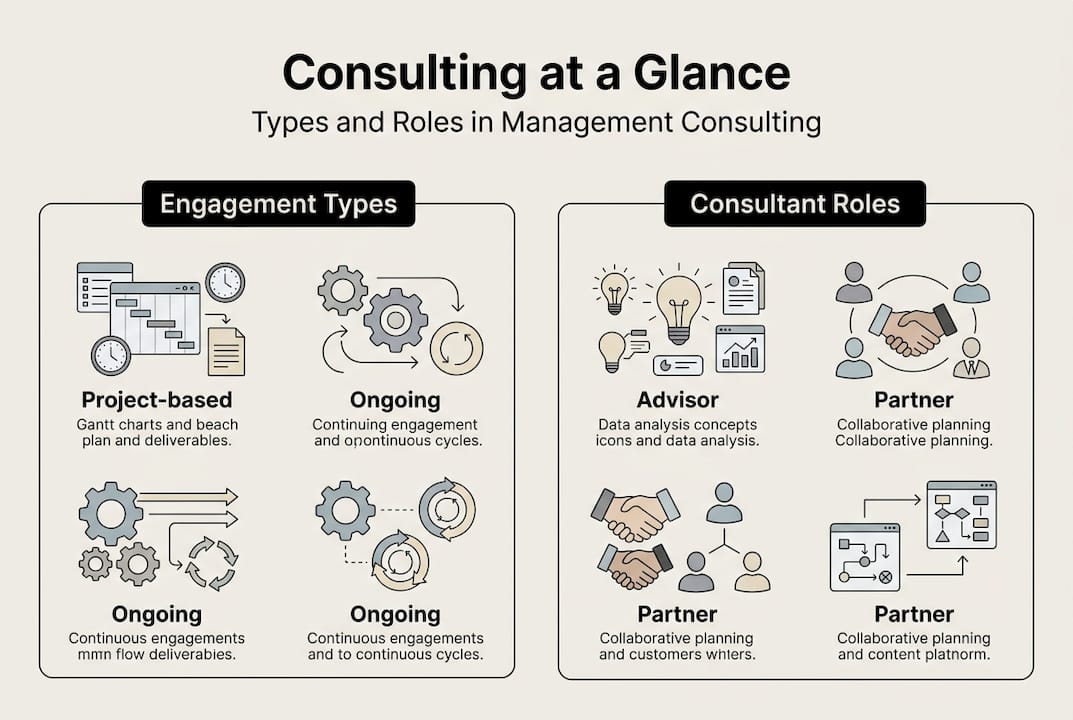
Consulting can be episodic, brought in for a specific project, or ongoing, where consultants serve as strategic partners over time. The right model depends on your business needs, urgency, and the complexity of the challenge. Exploring consulting services and business growth in depth reveals how different engagement models produce different outcomes. For a broader view of the discipline, the business consulting guide covers the full strategic landscape.
Core methodologies and frameworks in management consulting
Frameworks are the tools consultants use to structure thinking, diagnose problems, and communicate solutions clearly. Without them, consulting engagements risk becoming expensive brainstorming sessions. With the right framework, a complex organizational problem becomes a structured, solvable challenge.

Top consulting frameworks include McKinsey 7S, the GE-McKinsey Matrix, the Pyramid Principle, MECE (Mutually Exclusive, Collectively Exhaustive), the BCG Matrix, and Porter’s Five Forces. Each serves a distinct purpose.
| Framework | Primary use | Best for |
|---|---|---|
| McKinsey 7S | Organizational alignment | Restructuring, culture change |
| BCG Matrix | Portfolio management | Resource allocation decisions |
| Porter’s Five Forces | Market analysis | Competitive strategy |
| MECE | Problem structuring | Issue diagnosis, analysis |
| Pyramid Principle | Communication | Executive presentations, reports |
| GE-McKinsey Matrix | Business unit prioritization | Multi-division strategy |
The MECE principle deserves special attention. It ensures that every issue in an analysis is covered without overlap, which prevents consultants from missing root causes or double-counting problems. The Pyramid Principle, developed at McKinsey, structures communication so that the key message comes first, supported by evidence below. Together, these two tools make consulting outputs far more actionable.
Choosing the right framework depends entirely on the business challenge. A company navigating a merger needs different tools than one trying to improve customer retention. Understanding corporate consulting frameworks in context helps leaders ask better questions when evaluating consulting proposals.
Pro Tip: When evaluating a consulting firm, ask which frameworks they plan to use and why. A firm that cannot explain its methodology clearly is unlikely to deliver structured, repeatable results.
How management consultants drive results
Knowing the frameworks is one thing. Understanding how consultants actually deploy them inside your organization is what separates a productive engagement from a wasted investment.
A typical consulting engagement follows five structured phases:
- Diagnosis — Consultants assess the current state through interviews, data analysis, and process observation
- Analysis — Root causes are identified using structured frameworks and quantitative modeling
- Solution design — Recommendations are developed, prioritized, and stress-tested against business constraints
- Implementation — Consultants work alongside internal teams to execute changes, not just advise on them
- Follow-up — Results are measured against agreed KPIs, and adjustments are made as needed
Structured analysis and implementation support are what separate high-impact engagements from those that stall at the recommendation stage. Internal buy-in is not optional. Strategy without execution is just a document.
Engagements may be short or span months and often involve blended teams where consultants and internal staff work side by side. This model accelerates knowledge transfer and builds internal capability that outlasts the engagement.
| Engagement type | Typical duration | Best suited for |
|---|---|---|
| Project-based | 1 to 6 months | Specific problem, defined scope |
| Program-based | 6 to 18 months | Large transformation, multiple workstreams |
| Retainer/ongoing | 12+ months | Strategic partnership, continuous improvement |
Understanding consulting engagement ROI is critical before committing to any model. The investment must be tied to measurable outcomes, not just deliverables. Reviewing business growth case studies from comparable organizations gives you a realistic benchmark for what results to expect.
Modern realities: The impact of AI and digital transformation on consulting
The consulting industry is changing faster than most clients realize. For decades, consultants held an information advantage. They knew things clients did not. AI has largely erased that gap.
“The firms that will lead consulting in the next decade are not the ones with the best slide decks. They are the ones that can execute alongside clients in a world where data is abundant and patience is not.”
AI shifts consulting from information arbitrage to hands-on execution and outcome-driven pricing. Clients no longer pay for access to knowledge. They pay for the ability to apply that knowledge under real-world constraints, at speed.
What this means for you as a business leader:
- Demand outcome-based pricing where fees are tied to measurable results, not hours billed
- Expect execution support, not just strategy documents
- Look for firms that use AI tools to accelerate analysis and scenario modeling
- Prioritize consultants with deep industry experience over generalists who rely on generic frameworks
Understanding AI in executive leadership is now a baseline expectation, not a differentiator. Firms that have integrated AI and consulting transformation into their delivery model can compress timelines and improve accuracy significantly. Importantly, AI will not replace business consulting, but it will replace consultants who refuse to adapt.
Pro Tip: Before signing any consulting contract, ask how the firm uses AI in its diagnostic and delivery process. The answer will tell you a great deal about how current their methodology actually is.
When should you hire a management consultant?
Not every business challenge requires external consulting. But some situations almost always benefit from it. Recognizing the triggers early saves time and prevents costly missteps.
Consulting is especially suitable for complex challenges, major transformations, or when in-house expertise is limited. Common triggers include:
- Market disruption that requires rapid strategic repositioning
- Mergers and acquisitions where integration complexity exceeds internal capacity
- Persistent underperformance in key business units or functions
- Digital transformation initiatives that require both technical and change management expertise
- Leadership transitions where new executives need objective assessments of the organization
- Rapid scaling where processes and structures have not kept pace with growth
Selecting the right consulting partner involves more than comparing proposals. You need to clarify your objectives before the first conversation. What specific outcome do you need? What is your timeline? What internal resources can you commit to the engagement? Cultural fit matters too. A consulting team that cannot communicate effectively with your leadership will struggle to build the internal buy-in that execution requires.
Measuring return on investment is not optional. Every engagement should begin with agreed KPIs and a clear baseline. Without measurement, you cannot distinguish a successful engagement from an expensive one. Exploring consulting for business growth with a results-focused partner ensures your investment is tied to outcomes that matter.
Pro Tip: Before hiring a consultant, write down the three specific outcomes you expect. If you cannot articulate them clearly, the engagement scope is not ready. Clarity on your end drives clarity in the consultant’s work.
Elevate your organization with expert management consulting
The gap between knowing what needs to change and actually changing it is where most organizations lose momentum. That gap is exactly where expert consulting delivers its highest value. At Dumex Business Consult, we work with business leaders to close that gap through structured, results-driven engagements built around your specific goals.
Our business strategy expertise helps organizations align leadership, operations, and market positioning for sustainable growth. Our project management solutions ensure that transformation initiatives are executed on time, within scope, and with measurable outcomes. And our leadership and management training programs build the internal capability your team needs to sustain results long after the engagement ends. If your organization is ready to move from strategy to execution, we are ready to help you get there.
Frequently asked questions
How do management consultants add value?
Consultants support strategy, analysis, and implementation for sustainable improvement. They bring independent perspective, proven frameworks, and execution support that internal teams often cannot provide on their own.
Which industries benefit most from management consulting?
Consulting spans all industries from finance to healthcare and technology. Any sector facing rapid change, competitive pressure, or operational complexity can benefit from structured external expertise.
What are the risks of hiring a management consultant?
Success depends on execution, alignment, and collaboration. The most common risks are lack of internal buy-in, over-reliance on external advice, and failure to implement recommendations after the engagement ends.
How long do consulting engagements last?
Episodic engagements may last under a year, but scope and complexity define the actual duration. Larger transformation programs often run 12 to 18 months or longer when sustained change is the goal.