
TL;DR:
- Most innovation fails because it is treated as a one-time event rather than an ongoing system.
- Building a culture with roles like Architects, Bridgers, and Catalysts fosters sustained innovation.
- Aligning innovation efforts tightly with business goals and creating psychological safety is essential for long-term success.
Most corporate leaders treat innovation as a special event, a quarterly offsite, a brainstorming session, or a one-time product launch. But episodic innovation rarely creates lasting competitive advantage. Real organizational growth comes from embedding innovation into daily operations, leadership behavior, and team culture. In this article, we break down exactly how to do that. You’ll learn how to categorize innovation types, apply a proven leadership framework, align innovation with business goals, and build the psychological conditions where bold ideas actually survive contact with reality.
Table of Contents
- Defining innovation for modern organizations
- The ABCs framework: Building a culture of innovation
- Aligning innovation strategy with business goals
- Sustaining innovation: Building innovation capital and psychological safety
- The executive edge: What most innovation playbooks miss
- Bring innovation to life in your organization
- Frequently asked questions
Key Takeaways
| Point | Details |
|---|---|
| Innovation is a daily capability | Sustained impact comes from embedding innovation into everyday operations, not one-off projects. |
| Leadership shapes innovation culture | Executives enable innovation by supporting diverse roles and fostering psychological safety. |
| Strategy alignment is critical | Innovation efforts must align with core business goals to maximize value and results. |
| Build innovation capital | Trust, credibility, and constructive conflict are essential for sustaining ongoing innovation. |
Defining innovation for modern organizations
Before building an innovation strategy, you need a working definition that goes beyond “being creative.” In corporate settings, innovation is any change that creates measurable value, whether it’s a dramatic market disruption or a quiet improvement to an internal process. Both matter. Both require deliberate leadership.
Here’s where most executives go wrong: they treat innovation as synonymous with invention. Invention is creating something entirely new. Innovation is applying change, at any scale, to generate value. That distinction matters enormously when allocating resources and setting expectations.
Innovation management researchers categorize innovation along a spectrum:
| Innovation Type | Description | Example |
|---|---|---|
| Routine | Incremental improvements within existing products or processes | Faster checkout flow in an app |
| Rapid | Faster product development using new methods | Agile sprints replacing waterfall cycles |
| Disruptive | New business models that reshape markets | Subscription services replacing retail purchases |
| Radical | Breakthrough technology or science | AI-powered diagnostics in healthcare |
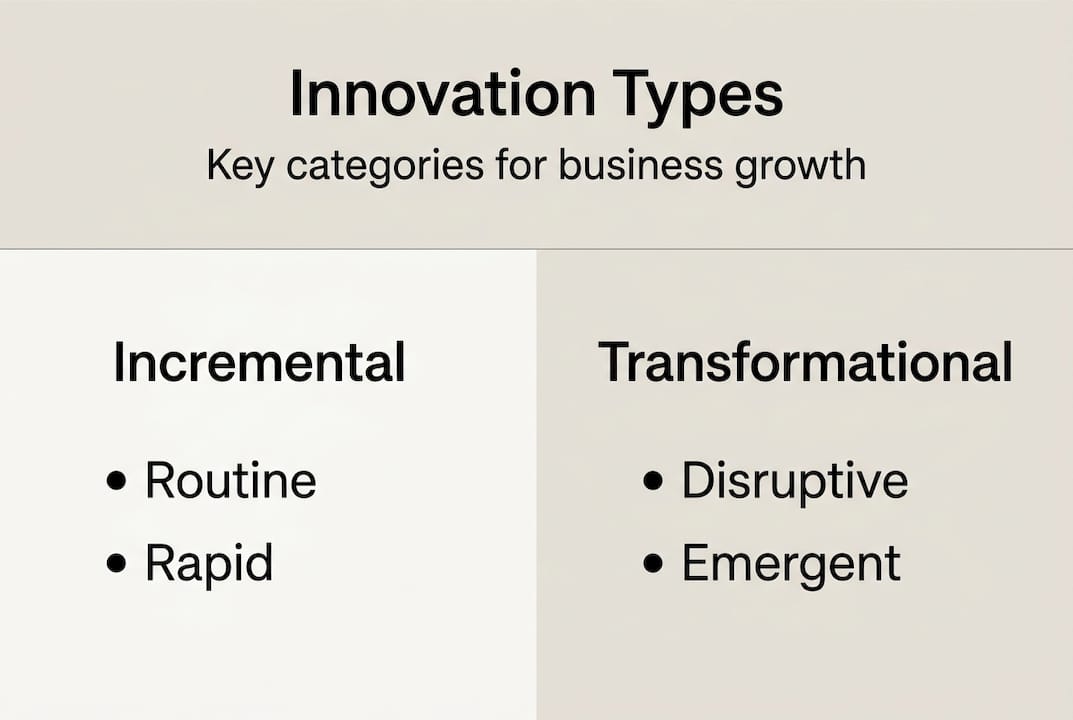
As innovation types and strategies differ for each category, copying a single approach across all four is a recipe for waste. The tactics that accelerate routine innovation, such as lean operations and continuous feedback loops, can actually stifle radical innovation, which needs protected space, longer timelines, and higher risk tolerance.
Some of the most common executive misconceptions about innovation include:
- Innovation only belongs to the R&D department
- Big budgets equal big results
- A single innovation leader can drive company-wide transformation
- Speed to market always outweighs strategic fit
These beliefs lead to what researchers call “innovation theater,” visible activity with little systemic impact. Understanding why innovation strategies fail often comes down to these exact myths going unchallenged at the executive level.
“The organizations that consistently outperform their peers don’t rely on occasional breakthrough moments. They build systems that make innovation a repeatable, organization-wide capability.”
That shift, from event to system, is the single most important mindset change for any senior leader serious about sustained growth.
The ABCs framework: Building a culture of innovation
Knowing your innovation types is necessary but not sufficient. The harder work is building the human infrastructure that makes innovation happen consistently. That’s where the ABCs framework becomes essential.
Leadership must cultivate Architects, Bridgers, and Catalysts to foster system-wide innovation. Each role plays a distinct function in the innovation ecosystem, and organizations that ignore any one of them develop critical blind spots.
| Role | Primary Function | Key Strength |
|---|---|---|
| Architect | Designs the innovation system and sets strategic direction | Big-picture thinking, structure |
| Bridger | Connects people, ideas, and resources across silos | Relationship building, translation |
| Catalyst | Activates ideas and accelerates experimentation | Energy, bias to action |
Here’s how to deliberately build a culture of innovation using the ABCs framework:
- Audit your current talent for natural ABCs tendencies. Most teams are Catalyst-heavy and Bridger-poor.
- Assign Architects to strategy sessions where systemic design decisions are made, not just project managers.
- Identify informal Bridgers who already connect people across departments. Give them visibility and resources.
- Protect Catalysts from bureaucracy. Channel their energy into early-stage pilots with clear go/no-go criteria.
- Rotate team compositions across innovation projects so each role interacts with the others consistently.
- Measure contribution by role, not just by output. Bridgers rarely get credit in traditional KPI systems.
Supporting innovation through strong leadership development means recognizing that organizational structure often works against the very people enabling innovation. Bridgers, in particular, are frequently overlooked in formal reward systems despite being the connective tissue between ideas and execution.

Pro Tip: Your most effective Bridgers probably aren’t your most senior people. Look for mid-level managers with strong cross-functional relationships. Identify them through peer feedback surveys and give them intentional exposure to executive innovation decisions. A good corporate consultant can help you surface these informal network leaders quickly.
Aligning innovation strategy with business goals
A culture of innovation without strategic alignment is expensive noise. You’ll generate plenty of ideas, but few of them will move the business forward in ways that matter.
Innovation strategy should create and capture business value, and that means every innovation initiative should trace directly back to a core business objective, whether that’s revenue growth, customer retention, cost efficiency, or market expansion.
The risk of misalignment is significant. Teams invest time and budget pursuing innovations that are technically impressive but strategically irrelevant. Leadership gets excited, resources shift, and then the initiative stalls because it doesn’t connect to how the organization measures success. The result is change fatigue, a condition where employees become cynical about the next big initiative because the last three didn’t stick.
Practical alignment steps for executives include:
- Define your innovation mandate clearly. Are you trying to defend market share, enter new markets, or reduce operational cost? Each goal requires a different innovation portfolio.
- Map every active innovation initiative to a specific strategic priority. If you can’t make the connection, pause the initiative.
- Create an innovation review cadence at the executive level, quarterly at minimum, where alignment is actively assessed.
- Involve finance early. Innovation investments should have defined return hypotheses, not just activity metrics.
- Communicate the “why” relentlessly. Teams lose alignment when they understand the what but not the business reason behind it.
Strategies for driving business growth consistently show that companies with formally aligned innovation portfolios outperform those that manage innovation as a separate function with no line of sight to core strategy.
Pro Tip: Replace vanity innovation metrics, like number of ideas submitted, with outcome-linked KPIs. Track metrics like “percentage of revenue from products launched in the last 24 months” or “cost savings attributed to process innovation this quarter.” These connect directly to board-level conversations and keep innovation grounded in reality. Reviewing corporate consulting strategies can help your team design a KPI architecture that actually reflects innovation impact.
Sustaining innovation: Building innovation capital and psychological safety
Alignment creates direction. But sustaining innovation over time requires something less tangible and far harder to build: the right conditions for people to take risks without fear of career damage.
Innovation capital is the combination of reputation, credibility, and collaborative relationships that gives leaders and teams the organizational “permission” to pursue bold, uncertain ideas. Leaders with strong innovation capital can push unconventional initiatives through resistance. Those without it watch the same ideas die in committee.
Building innovation capital requires consistent behavior over time:
- Delivering on past commitments, even small ones, builds credibility
- Publicly acknowledging failure as a source of learning, not a mark against performance
- Investing in relationships across functions before you need those functions’ support
- Championing others’ ideas visibly, not just your own
- Sharing credit broadly and consistently
But innovation capital alone isn’t enough if people are afraid to use it. Top teams struggle with psychological safety and conflict management when building innovation capability, and that finding should concern every senior leader.
Consulting experience in business growth support consistently reveals the same pattern: organizations that report high innovation output also report cultures where disagreement is expected, not avoided. Conflict, managed well, is actually a signal of a functioning innovation culture.
“Real learning happens at the edge of discomfort. If every meeting ends in consensus, you’re not innovating. You’re performing alignment.”
The role of consulting services in this context is often to create the structured conflict that internal teams avoid. An outside perspective surfaces assumptions, challenges orthodoxies, and gives leadership teams permission to have the hard conversations that build genuine innovation capability.
The executive edge: What most innovation playbooks miss
Here’s the uncomfortable truth most leadership books skip over: frameworks don’t innovate. People do. And people only take creative risks when they trust that failure won’t end their career or damage their reputation.
Most corporate innovation programs invest heavily in process and lightly in trust. You get the innovation lab, the design thinking workshop, and the idea-submission portal. But without executives who model vulnerability, who say “I was wrong about that,” or who visibly back an initiative even when early results are ugly, the whole system collapses into theater.
True innovation culture isn’t built on slogans or strategy decks. It’s built on persistent, discomforting action. That means backing experiments that look risky. It means protecting a team member who failed while trying something genuinely new. It means engaging with organizational change strategies that challenge executive behavior, not just process design.
The leaders who build lasting innovation capacity do one thing differently: they treat their own discomfort as a signal they’re on the right track, not a warning to retreat.
Bring innovation to life in your organization
Understanding innovation frameworks is one thing. Implementing them inside a complex organization with competing priorities and established habits is another challenge entirely.

At Dumex Business Consult, we work directly with executive teams to translate strategy into sustained action. From business strategy consulting that aligns innovation to your core growth objectives, to leadership development programs that build the ABCs capabilities your organization needs, our approach is practical, measurable, and built for your specific context. Whether you’re starting your innovation journey or scaling what’s already working, our business consulting guide is a strong first step toward clarity and momentum.
Frequently asked questions
What are the main types of innovation in business?
Routine, rapid, and disruptive innovation are the core types, and each requires a different leadership approach, resource model, and risk tolerance to succeed.
How can executives ensure innovation aligns with business strategy?
Start by mapping every active initiative to a specific strategic goal, and use outcome-linked KPIs rather than activity metrics. Innovation aligned to value creation consistently outperforms innovation managed as a standalone function.
Why do innovation initiatives often fail in large companies?
Top teams struggle with psychological safety and conflict management, which creates environments where people avoid the risky thinking that real innovation requires.
What is ‘innovation capital’ and why does it matter?
Innovation capital is the trust, credibility, and relationships that give leaders the organizational permission to pursue bold and uncertain ideas without being shut down by internal resistance.
Recommended
- Understanding Why Innovation Strategies Fail and How to Overcome Them
- Innovation and business growth: The real strategy in 2026
- Effective Business Strategies for Growth
- Driving Innovation for Sustainable Business Growth
- Master the multi-project management process: boost success
- Affärskonsult för Commercial Excellence & RevOps