


Most business leaders assume excellence is something you win, a plaque on the wall or a certification that signals you’ve arrived. That assumption is expensive. Business excellence is a philosophy that goes far beyond awards to enable sustainable success, built on systematic frameworks, continuous improvement, and leadership that never stops adapting. The real question isn’t whether your organization has been recognized. It’s whether your operations, culture, and strategy are structured to perform at their peak, year after year. This guide breaks down the core frameworks, what the evidence actually shows, the pitfalls that derail even well-intentioned programs, and how consulting makes the difference between theory and real transformation.
Table of Contents
- Defining business excellence: Core concepts and frameworks
- Measuring impact: Evidence, benchmarks, and results
- Pitfalls, barriers, and integration: Common obstacles and how to overcome them
- Evolving priorities: Sustainability, agility, and Industry 5.0
- Our perspective: Why business excellence is only part of the solution
- Take the next step: Consulting solutions for business excellence
- Frequently asked questions
Key Takeaways
| Point | Details |
|---|---|
| Frameworks guide excellence | Business excellence relies on flexible frameworks like EFQM and Baldrige for strategic improvement. |
| Evidence is mixed | Direct impact on growth is only partially validated, making a hybrid approach essential. |
| Pitfalls are common | Bureaucracy, leadership gaps, and award obsession can prevent genuine performance gains. |
| Evolving priorities matter | Modern frameworks now integrate sustainability, agility, and digital transformation. |
| Consulting enables real change | Strategic consulting tailors excellence frameworks for lasting, measurable improvement. |
Defining business excellence: Core concepts and frameworks
Business excellence is not a single methodology. It’s a collection of frameworks facilitating superior performance across leadership, strategy, people, processes, and results. Think of it as an operating philosophy that gives organizations a structured way to assess where they are and where they need to go.
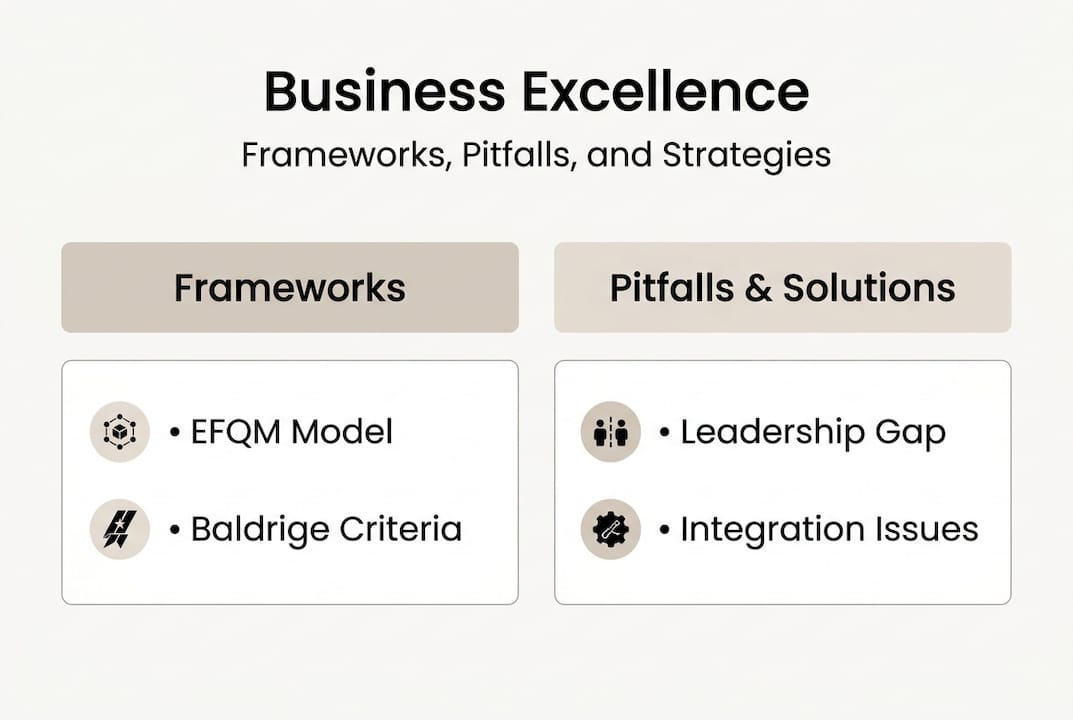
Two frameworks dominate the global conversation. The EFQM Model (European Foundation for Quality Management) is widely used across Europe and beyond, focusing on purpose, vision, strategy, and execution. The Baldrige Excellence Framework is the American equivalent, used extensively in the United States to evaluate organizational performance across seven categories including leadership, strategy, customers, workforce, and results.
What makes both frameworks powerful is their diagnostic nature. They are not prescriptive checklists. They give leaders a lens to identify gaps and opportunities without dictating exactly how to fix them. That flexibility is a feature, not a bug. It means a manufacturing firm and a healthcare provider can both use EFQM without forcing identical solutions onto very different problems.
For leaders exploring how to apply these tools strategically, a solid corporate consulting guide can help translate framework language into practical action.
Here’s a quick comparison of the two major frameworks:
| Feature | EFQM Model | Baldrige Framework |
|---|---|---|
| Origin | Europe | United States |
| Focus areas | Purpose, strategy, execution | Leadership, strategy, customers, results |
| Primary use | Diagnostics and improvement | Performance assessment |
| Prescriptive? | No | No |
| Award linked? | Yes (EFQM Award) | Yes (Baldrige Award) |
Key principles shared across both frameworks include:
- Results orientation: Decisions are driven by data and measurable outcomes
- Customer focus: Every process traces back to delivering value to the customer
- Leadership and purpose: Senior leaders set the tone and direction
- Continuous learning: Improvement is never finished
- Process management: Structured workflows reduce waste and variation
A strong quality management overview can show how these principles connect to day-to-day operational systems.
Measuring impact: Evidence, benchmarks, and results
Now that you understand the frameworks, let’s see what the data actually says about business excellence in practice. The honest answer is that the evidence is encouraging but not conclusive.
Empirical evidence linking business excellence adoption to sustained transformation is mixed, with most support coming indirectly from award winners rather than controlled studies. In fact, only 13% of studies on business excellence directly measure organizational performance impact. That’s a number worth sitting with.
What we do see from award-winning organizations is a consistent pattern. Companies in the top decile of excellence adoption tend to show stronger financial performance, higher employee engagement, and better market responsiveness over three to five year periods. The gains are real, but they take time and consistent effort to materialize.
One compelling EFQM case study from an electronics manufacturer shows exactly what systematic application looks like. After adopting the EFQM Model, the organization achieved measurable market share gains and significant cost reductions, driven by improved process discipline and leadership alignment. The key word there is systematic. The framework didn’t produce results on its own. Deliberate execution did.
For leaders tracking the quality systems impact of their investments, here are the metrics that matter most:
- Financial performance: Revenue growth, cost reduction, and profitability trends
- Employee engagement scores: Retention, satisfaction, and productivity indicators
- Customer satisfaction: Net Promoter Score, complaint rates, and loyalty metrics
- Process efficiency: Cycle times, defect rates, and waste reduction percentages
- Market anticipation: Speed of innovation and responsiveness to competitive shifts
The takeaway is clear. Business excellence frameworks are not magic. They are structured starting points. Organizations that treat them as living tools rather than static checklists are the ones that see compounding results over time.
Pitfalls, barriers, and integration: Common obstacles and how to overcome them
Despite promising results, leaders often face critical obstacles, so let’s examine the most common pitfalls and actionable solutions.

Frameworks are best for diagnostics but pitfalls include bureaucracy and insufficient leadership buy-in. These two issues alone account for the majority of stalled excellence programs. When frameworks become paperwork exercises rather than strategic tools, they lose their power almost immediately.
Small and medium enterprises (SMEs) face a distinct version of this challenge. They often lack the internal resources to run a full self-assessment process while also managing daily operations. Large organizations, on the other hand, can fall into the trap of over-engineering their approach, creating committees and documentation layers that slow momentum rather than build it.
“An excellence framework that sits in a binder is not a strategy. It’s a liability.”
The good news is that business excellence integrates well with Lean and Six Sigma methodologies, creating a combined approach that is both diagnostic and operational. Lean eliminates waste. Six Sigma reduces variation. Business excellence frameworks provide the strategic context that ties both together.
Pro Tip: Don’t start with a full framework assessment. Start with one strategic priority, apply the framework lens to it, and build momentum from a visible win before expanding.
Here are the most common obstacles and how to address them:
- Bureaucratic overload: Simplify the self-assessment process and focus on high-impact criteria first
- Lack of leadership buy-in: Tie excellence metrics directly to executive KPIs and compensation
- Awards obsession: Reframe success around operational improvement, not trophy collection
- SME resource constraints: Use consulting support to run lean assessments without internal overhead
- Siloed implementation: Integrate excellence criteria into existing strategy and planning cycles
Leaders looking to understand how consulting services can remove these barriers will find that external expertise accelerates adoption significantly. A business consulting guide can also help you identify which obstacles are most relevant to your organization’s current stage.
Evolving priorities: Sustainability, agility, and Industry 5.0
Business excellence isn’t static. Let’s explore how evolving priorities are reshaping its role.
Recent evolutions of business excellence frameworks now emphasize sustainability, agility, and Industry 5.0 as core dimensions of organizational performance. This is a significant shift. Earlier versions of EFQM and Baldrige were primarily focused on operational and financial outcomes. Today, the conversation includes environmental responsibility, human-centered technology, and the capacity to pivot quickly in uncertain markets.
Industry 5.0 is worth understanding clearly. It moves beyond Industry 4.0’s automation focus to emphasize collaboration between humans and technology, with sustainability and resilience as primary goals. For business leaders, this means excellence frameworks now need to account for how your organization uses technology to empower people, not just replace them.
Modern consulting approaches tailor business excellence to these new priorities by helping organizations map their digital transformation efforts against framework criteria. This prevents the common mistake of running a digital strategy and an excellence program as two separate initiatives.
It’s also worth noting a geographic reality. Business excellence frameworks are heavily concentrated in Europe, North America, and parts of Asia. Organizations in other regions may need additional customization to make these tools relevant to their specific market conditions and regulatory environments.
Here are actionable steps leaders can take right now:
- Audit your current framework against sustainability and agility criteria to identify gaps
- Map digital transformation goals to excellence framework categories for integrated planning
- Engage consulting partners who understand both framework methodology and Industry 5.0 principles
- Build agility into your KPIs by tracking speed of decision-making and adaptation alongside financial metrics
- Involve your workforce in excellence reviews to capture ground-level insights that leadership often misses
For leaders ready to act, exploring consulting and business growth resources can show how these priorities translate into practical strategy. Understanding corporate consulting strategies designed for modern organizations is a strong next step.
Our perspective: Why business excellence is only part of the solution
Here is the uncomfortable truth most framework advocates won’t tell you. A high score on any excellence model does not guarantee a high-performing organization. Frameworks diagnose. They don’t transform.
We’ve seen organizations achieve strong assessment scores while their culture quietly erodes, their best people leave, and their strategy drifts. The non-prescriptive nature of these frameworks suits tailored consulting well, but hard data confirming direct performance impact remains limited. That limitation is a feature only if leaders use it wisely.
The real driver of business excellence is leadership’s ability to take a diagnostic tool and translate it into specific, courageous decisions. That requires more than a framework. It requires judgment, adaptability, and a consulting relationship that challenges assumptions rather than validates them.
Pro Tip: Treat your excellence framework as a conversation starter, not a report card. The most valuable output is the strategic dialogue it creates, not the score it produces.
Understanding the role of a corporate consultant in this process is essential. The best consultants don’t just assess. They push leaders to act on what the assessment reveals, and they stay accountable for results.
Take the next step: Consulting solutions for business excellence
If this guide has shown you anything, it’s that frameworks are tools, not destinations. The organizations that achieve lasting excellence are the ones that combine structured diagnostics with expert guidance and decisive leadership action.
At Dumex Business Consult, we work with business leaders to translate framework insights into real operational improvements. Whether you need to sharpen your business strategy solutions, strengthen your leadership and management capabilities, or build a rigorous total quality management system, our team brings the expertise to make it practical and measurable. We don’t hand you a framework and walk away. We stay in the work with you until the results show up where they matter most.
Frequently asked questions
How does business excellence differ from Total Quality Management?
Business excellence contrasts with rigid TQM by offering a flexible, strategic philosophy focused on diagnostics, whereas TQM is more process-driven and operationally focused. Excellence frameworks cover the entire organization, not just quality processes.
Is there evidence that business excellence frameworks drive growth?
Evidence is mixed. Only 13% of studies directly measure performance impact, though award-winning organizations often show indirect gains in financial performance and market responsiveness over multi-year periods.
Why do some organizations struggle to implement business excellence?
Common pitfalls include bureaucracy without leadership buy-in and an excessive focus on awards or documentation rather than genuine operational improvement and strategic alignment.
How are business excellence frameworks evolving in 2026?
Modern frameworks now emphasize sustainability, agility, and Industry 5.0 principles, expanding beyond traditional financial and operational metrics to include resilience, human-centered technology, and environmental responsibility.
Can consulting help adapt business excellence to unique business needs?
Yes. Consulting professionals use the non-prescriptive nature of excellence frameworks to build custom diagnostics and improvement plans that fit each organization’s specific strategy, size, and industry context.
