
TL;DR:
- Operational efficiency optimizes existing processes to reduce costs without sacrificing quality.
- Success requires clear goals, employee engagement, and ongoing leadership sponsorship.
- Regular measurement and accountability are essential to prevent efficiency gains from fading over time.
Most organizations launch efficiency programs with real ambition, only to watch the gains quietly disappear. 75% of cost programs are not very successful, and 48% of organizations experience costs creeping back after initial improvements. That is not a minor implementation problem. It points to a deeper gap in how most leaders think about efficiency itself. This guide breaks down what actually drives sustainable operational efficiency, from setting the right goals and engaging your people, to measuring results and preventing the inevitable backslide. If you are serious about lasting improvement, not just a temporary win, this is where to start.
Table of Contents
- Understanding operational efficiency: What it is and why it matters
- Laying the groundwork: Setting clear goals and employee engagement
- Practical strategies to improve operational efficiency
- Measuring results and preventing setbacks
- The overlooked reality: Why efficiency fades and how to make it last
- Advance your efficiency journey with proven solutions
- Frequently asked questions
Key Takeaways
| Point | Details |
|---|---|
| Define your outcomes | Set clear, measurable goals before launching efficiency initiatives. |
| Engage your team | Involve employees for sustainable results and continuous improvement. |
| Monitor and adapt | Track efficiency metrics and refine processes to prevent setbacks. |
| Efficiency is a habit | Making efficiency sustainable requires active leadership and ongoing commitment. |
Understanding operational efficiency: What it is and why it matters
Operational efficiency is the ability of an organization to deliver its products or services at the lowest possible cost without sacrificing quality or speed. It is about getting more output from the same input, whether that input is time, money, people, or equipment. For medium and large organizations, even a modest improvement in efficiency can translate into millions of dollars in recovered value.
But here is where many leaders go wrong. They treat efficiency and transformation as interchangeable. They are not. As one critical distinction makes clear, operational efficiency is not the same as transformation, and success depends on understanding that difference. Efficiency optimizes what already exists. Transformation reimagines the system entirely. Confusing the two leads to misaligned investments and failed programs.
| Factor | Operational efficiency | Organizational transformation |
|---|---|---|
| Focus | Optimizing existing processes | Reinventing business models |
| Timeline | Short to medium term | Long term |
| Risk level | Moderate | High |
| Primary driver | Cost and speed | Innovation and growth |
| Employee impact | Process-level changes | Cultural and structural shifts |
For most organizations, the right approach is not one or the other. It is knowing when each applies. Efficiency is your foundation. Without it, transformation efforts collapse under the weight of operational drag.
Key benefits of strong operational efficiency for medium and large organizations include:
- Lower operating costs without reducing output quality
- Faster decision-making through streamlined workflows
- Higher employee productivity when friction is removed from daily tasks
- Improved customer satisfaction from consistent, reliable delivery
- Greater resilience when market conditions shift
For a broader look at what this means in practice, the operational excellence guide from Dumex Business Consult covers the full picture. And if you want to see how leading organizations are putting this into action, the operational excellence strategies resource is worth reviewing before you build your own plan.
Laying the groundwork: Setting clear goals and employee engagement
Before any process gets touched, two things must be in place: specific goals and genuine employee buy-in. Lack of clear goals and insufficient employee engagement are among the most common reasons efficiency initiatives fail to deliver lasting results. Vague objectives like “reduce waste” or “improve speed” give teams nothing concrete to work toward.

Goals need to be measurable and time-bound. Instead of “reduce costs,” target “reduce processing costs by 12% within six months.” That specificity creates accountability and makes it possible to track real progress.
Employee engagement is equally non-negotiable. People who feel excluded from change initiatives tend to resist them, sometimes subtly, sometimes openly. Here is a practical sequence for building early alignment:
- Identify key stakeholders across departments who will be directly affected by efficiency changes.
- Communicate the why before the what. Explain the business case in plain terms, not just executive-level strategy.
- Create feedback channels so employees can flag real-world friction points that leaders may not see.
- Pilot changes in one team or unit before scaling, using frontline input to refine the approach.
- Recognize early adopters publicly to signal that participation is valued and visible.
| Common pitfall | Why it happens | How to avoid it |
|---|---|---|
| Goals are too broad | Leadership avoids specificity to stay flexible | Set SMART targets with clear owners |
| Employees feel blindsided | Changes announced without context | Involve staff in planning, not just rollout |
| Middle managers disengage | They feel bypassed or threatened | Give managers a defined role in the process |
| Progress is not communicated | Leaders assume results speak for themselves | Share updates regularly, even small wins |
Building operational efficiency workflows that actually stick requires this kind of structural groundwork. For a deeper look at how consulting frameworks support this alignment work, the consulting strategies for success resource covers the organizational side in detail.
Pro Tip: Run a short anonymous survey before launching any efficiency initiative. Ask employees where they experience the most friction in their daily work. The answers will surface bottlenecks that no process map will show you.
Practical strategies to improve operational efficiency
With goals set and people aligned, the real work begins. Most organizations make the mistake of jumping straight to solutions before fully understanding the problem. That is how you end up automating a broken process instead of fixing it.
As one sharp observation about the missing middle in execution notes, vision and reimagination must come before execution, not after. That means diagnosing before acting.
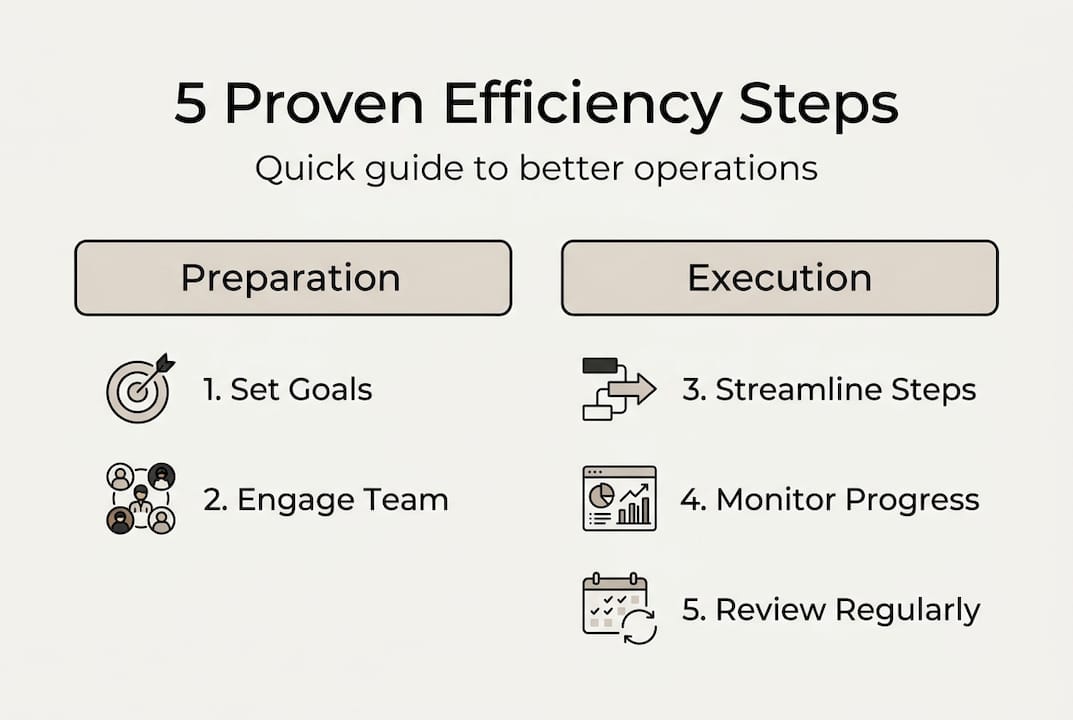
Here is a practical sequence for improving operational efficiency at the process level:
- Map your current processes end to end. Identify every handoff, approval, and delay point.
- Quantify the cost of each bottleneck. Time lost, errors generated, and rework required all have dollar values.
- Prioritize by impact and effort. Focus first on high-impact, lower-effort improvements for early momentum.
- Introduce technology selectively. Automation works best on repetitive, rule-based tasks. Do not automate complexity.
- Use data to validate changes. Every process change should be tested against a baseline metric before full rollout.
- Document new workflows clearly so improvements do not live only in people’s heads.
Quick-win actions that deliver immediate impact:
- Eliminate redundant approval layers that slow decisions without adding oversight value
- Standardize communication templates for recurring internal requests
- Consolidate tools where teams are using multiple platforms for the same function
- Shift reporting from manual compilation to automated dashboards
- Review vendor contracts for services that are underused or duplicated
For organizations that need tailored approaches rather than generic frameworks, custom business solutions can accelerate this diagnostic phase significantly. The business growth strategies resource also connects efficiency improvements directly to revenue outcomes.
Pro Tip: Schedule a quarterly process review as a standing agenda item in leadership meetings. Efficiency is not a project with an end date. Treating it as one is exactly how costs creep back.
Measuring results and preventing setbacks
Implementing improvements is only half the work. The harder part is making them stick. 48% of COOs report that costs creep back after initial efficiency improvements, which means the measurement and monitoring phase is where most programs either hold or collapse.
“48% of organizations experience costs creeping back after initial improvements, and only 25% of cost programs are truly successful over the long term.” This is not a warning to ignore.
Core KPIs to track for operational efficiency include:
- Cycle time: How long does it take to complete a process from start to finish?
- Cost per unit: What does it cost to produce one unit of output?
- Error rate: How often do processes produce defects or require rework?
- Resource utilization: Are your people, equipment, and systems being used at optimal capacity?
- Employee productivity: Output per person over a defined period
Common causes of efficiency losses and how to prevent them:
- No ownership assigned: Assign a named process owner for every critical workflow
- Metrics tracked but not acted on: Build a review cadence where data triggers decisions, not just reports
- Change fatigue: Pace initiatives so teams can absorb improvements before the next wave hits
- Senior leadership disengagement: Efficiency programs lose momentum when executives stop asking about them
- Lack of feedback loops: Create structured ways for frontline staff to flag when old habits return
Understanding the hidden costs of inefficiency is essential context here, because the losses are rarely visible until they compound. For organizations going through larger structural shifts, the business transformation insights resource connects measurement practices to broader change management.
The overlooked reality: Why efficiency fades and how to make it last
Here is something most efficiency consultants will not say out loud: the majority of efficiency programs fail not because of bad strategy, but because of bad sponsorship. Only 25% of cost programs are truly successful over the long term, and the gap between the 25% and the rest almost always comes down to leadership behavior, not process design.
We see this pattern repeatedly. An organization invests in process mapping, technology upgrades, and training. Results look promising in the first quarter. Then a senior leader shifts focus to the next priority, middle managers stop reinforcing new behaviors, and within a year the old patterns return. The process changed. The system did not.
The real missing middle is not a methodology gap. It is the absence of sustained senior sponsorship and genuine employee ownership. Efficiency has to become a leadership habit, something that gets asked about in every operations review, not just during the program launch. The organizations that get this right treat efficiency the way they treat financial performance: as an ongoing discipline with named owners, regular reporting, and real consequences for backsliding. Reviewing transformation vs. operational efficiency through that lens changes how you structure accountability from the start.
Advance your efficiency journey with proven solutions
Sustaining operational efficiency at scale requires more than internal effort. It takes structured frameworks, external perspective, and the right expertise applied at the right moment.

At Dumex Business Consult, we work with medium and large organizations to build efficiency that holds. Our Total Quality Management solutions help you embed quality into every process, not just inspect for it at the end. Our project management services keep improvement initiatives on track and accountable. And our HR management support ensures your people strategy aligns with your operational goals. If you are ready to build efficiency that does not fade, reach out to us for a tailored strategy session.
Frequently asked questions
What is the first step to improve operational efficiency in a large organization?
Start by setting clear, measurable goals and engaging key employee groups to ensure alignment and early buy-in. Vague objectives and low engagement are the leading barriers to lasting efficiency gains.
How is operational efficiency different from digital transformation?
Operational efficiency focuses on optimizing existing processes, while transformation involves reimagining and reinventing the business model entirely. Confusing the two leads to misaligned investments and programs that fail to deliver.
What metrics should I track to measure operational efficiency?
Monitor KPIs such as cycle time, cost per unit, error rates, and resource utilization for ongoing assessment. Consistent metric tracking is what separates organizations that sustain improvements from those that lose them.
Why do cost savings often disappear after efficiency programs?
Many organizations fail to assign clear ownership or enforce ongoing monitoring, which allows old habits to return. 48% of COOs report costs creeping back after initial improvements precisely because of this gap.
How can consulting help sustain operational efficiency?
Consulting brings external expertise, proven frameworks, and ongoing accountability that internal teams often cannot maintain alone. Structured consulting support helps align culture, process, and leadership around long-term efficiency goals.